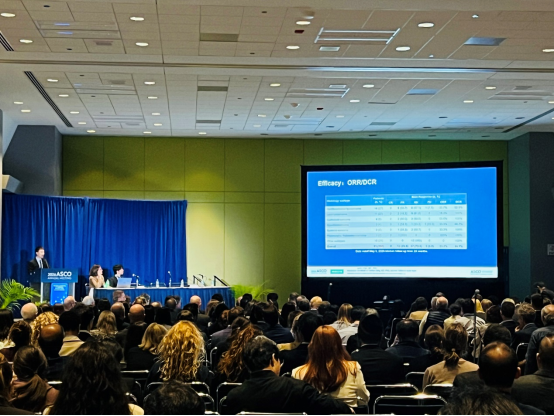
From May 29 to June 2, the 2026 American Society of Clinical Oncology (ASCO) Annual Meeting was held in Chicago. Professor Jiang Yu's team from the Head and Neck Oncology Ward at the Cancer Center of West China Hospital, Sichuan University (WCH), had their research selected for oral presentation at the Sarcoma Rapid Oral Presentation Session. This follows their ERAS (Enhanced Recovery After Surgery) study, which was also presented as an oral report at last year's ASCO meeting. The team's work has once again earned a place on this premier global oncology stage.
At the conference, team members detailed the study design, key findings, and future research directions. They engaged in in-depth discussions with experts on topics including maintenance treatment strategies for advanced soft tissue sarcoma, differences across pathological subtypes, and biomarker-driven precision therapy. This presentation fully demonstrated the team's solid foundation in clinical research on soft tissue sarcoma, as well as WCH's strength in clinical innovation and international academic exchange.
Soft tissue sarcoma accounts for approximately 1% of adult malignancies, making it a rare tumor. For patients with advanced soft tissue sarcoma, anthracycline-based chemotherapy remains an important first-line treatment. However, when the disease is controlled after chemotherapy, patients often cannot continue the same regimen due to cumulative toxicity. There is currently no clear consensus on the optimal subsequent treatment strategy. Building on previous research on anlotinib maintenance therapy, Professor Jiang Yu's team further conducted the TORANS study. This trial evaluated the benefit of combining toripalimab with anlotinib as maintenance therapy after first-line chemotherapy in patients with advanced soft tissue sarcoma. The study confirmed that this combination maintenance regimen demonstrated good efficacy and safety, providing new evidence for post-chemotherapy treatment options in advanced soft tissue sarcoma.